Tried a couple of MACROS
This is the actual size of the spider
Thursday, June 5, 2008
Assignment #4 Macro


Tuesday, May 27, 2008
Aperture?
Aperture is one of those words that scares a lot of people. It’s something that a lot of us know is there but don’t want to deal with. After all, that’s why we bought an automatic camera. But aperture is something that every photographer should be aware of, amateur or not. It is one of the cameras functions that set out limitations for every photo we take.
The aperture in a camera is a function of the lens. It works the same way that the iris of our eye works. If you haven’t already experienced this phenomenon in science class then grab a flash light and go to a mirror. First turn out all the lights and wait for a few seconds. Turn the lights back on and look into the mirror. Your pupils should be wide open. Now, quickly, shine the flashlight right into your eyes. The pupils will close up pretty quick. This is because your eye is monitoring how much light it lets in, taking only what it needs.
This is the exact primary function of a lens’s aperture. An automatic camera will have a light sensor that measures how much light is entering the lens. In a situation where there is a lot of light it will close the aperture to a finer point because it doesn’t want to over expose the picture. For photos taken in doors or even at night, the aperture will be opened up.
This function of the aperture works hand in hand with the camera’s shutter. Imagine that the camera has an option to keep the shutter open—thereby exposing the film or CCD to light—for anywhere from a hundredth of a second to an entire second. That means the shutter can open and close really fast or really slowly. If too much light enters the camera during any one of these scenarios the picture would be exposed too much. Now let’s get back to the aperture. If the camera’s aperture is opened wide then a lot of light can get in and the shutter won’t have to be open as long. Conversely, if the aperture is closed to a fine point then not as much light gets in and the shutter will have to be open longer.
Before the days of automatic exposures a photographer had to do a bit of math to determine the best way to balance these things. These days the camera does most of the work for you. But it isn’t always right! Why? Because the aperture also affects the focus.
Imagine a billion rays of light racing into a lens. The narrower the opening, the more focused those rays will become. In practical terms this means if you took a picture of a person with a wide open aperture then the person may be in focus, but everything in front of them and behind them may be blurry. The more the aperture is closed, the finer the light entering the camera becomes and, in turn, more things get focused. All of a sudden the person is sharp as is the fence behind them and the tree, etc.
The aperture, therefore, acts as both a technical means of taking a photo and a way of adjusting the pictures aesthetics.
Note as well that in photography the aperture is represented by numbers known as F-stops. The higher the F-stop is, the more the aperture is closed.
Monday, May 26, 2008
Assignment #3 Colors
Our third assignment was themed as "Colors". Time for my trusty Nikon D40x, nikkor 18-135, extension tubes , table lamps, and DIY product table again!

First trial using jelly beans and sunflower seed chocolates

Jelly beans

Sunflower seeds (chocolate costed nuts) They are about
half an inch in length.

Combination on jelly beans and sunflower seeds

My final edition of jelly beans. I used the focusing in-out technique to get this
effect. You use a slow shutter and pre-focus on the subject.
Focus it in (Max focus) and click the shutter. Now while
waiting for the shutter to close you smoothly focus out until the shutter closes.
The jelly beans here were placed on top of a bond paper
on a glass table and I placed a table lamp under it and another one on top.
I won 2nd place here. :)
Sunday, May 25, 2008
Assignment #2 Motion
Our professor asked us to shoot something in motion or freeze a motion. It took me quite some time to decide what to take. So I decided to shoot water droplets. So I took my Nikon D40x with 18-135mm and manual extension tubes I also got my trusty table lamps again and my daughters writing table and put it in front of our ref. My wife saw me when she got home and laughed at me and said I'm crazy! hehehehe! Don't have the budget to buy a decent product table but I believe it's really not the equipment to get great photos (although it really helps!) but the eye and imagination of the photographer that captures great photos!

My set-up! My own DIY product table. Our ref as my backdrop.

My first trial and didn't quite like it! :(
 My final and winning shot! I won in our class! :)
Saturday, May 24, 2008
Assignment #1 of my Photography workshop
Our professor gave us the theme "Single Light source" as our first assignment.

This was the set-up of my assignment. I was holding the table lamp
while my camera was on my tripod. I inserted the carton of our
toilet paper (the circular one that we usually imagine when we were
kids that it's a telescope :)) to the table lamp bulb to concentrate
the light. I used the glass table to reflect the subject (fruits) and put
a black thingy below the table for added reflection.
 My final image entitled "In the Middle". There's no post processing
done here. What you see is the shot I took direct from the camera.
I got a special mention in class and won a photography magazine. :)
Friday, May 23, 2008
Concept of Permanent Photos
Conception of permanent images

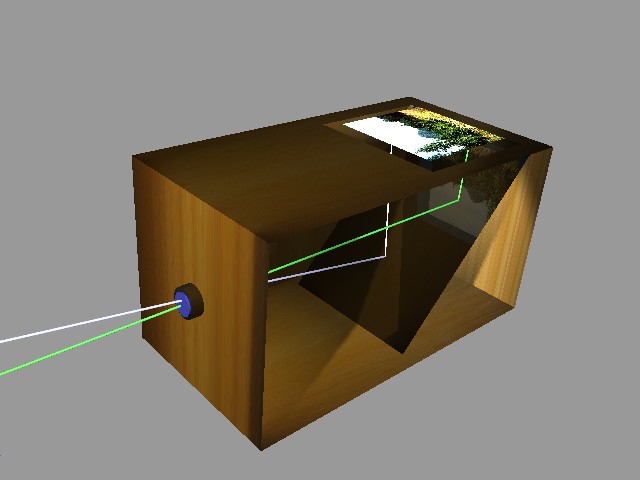
Photography is the result of combining several technical discoveries. Long before the first photographs were made, Ibn al-Haytham (Alhazen) (965–1040) invented the camera obscura and pinhole camera, Albertus Magnus (1139-1238) discovered silver nitrate, and Georges Fabricius (1516-1571) discovered silver chloride. Daniel Barbaro described a diaphragm in 1568. Wilhelm Homberg described how light darkened some chemicals (photochemical effect) in 1694. The fiction book Giphantie (by the French Tiphaigne de la Roche, 1729-1774) described what can be interpreted as photography.
For centuries, images have been projected onto surfaces. According to the Hockney-Falco thesis as argued by artist David Hockney, some artists used the camera obscura and camera lucida to trace scenes as early as the 16th century. However, this theory is heavily disputed by today's contemporary realist artists who are able to create high levels of realism without optical aids. These early cameras did not fix an image, but only projected images from an opening in the wall of a darkened room onto a surface, turning the room into a large pinhole camera. The phrase camera obscura literally means dark chamber. While this early prototype of today's modern camera may have had modest usage in its time, it was an important step in the evolution of the invention.
Subscribe to:
Posts (Atom)


